Pi Network deserves credit for one genuinely historic achievement: it proved that tens of millions of ordinary people, most of whom had never opened an exchange account in their lives, would happily interact with a crypto app every single day if you removed the friction. No hardware. No electricity bill. No seed phrase panic on day one. Just a phone, a button, and a reason to come back tomorrow.
The problem is that the fixture list never really progressed. Years of closed mainnet, a KYC backlog that became folklore, and a token that spent most of its life trading as an IOU left a very large audience with the habit but nowhere to spend it. That audience is now the most interesting free transfer market in crypto — millions of trained daily users looking for a side that actually plays football.
We scouted the entire mobile-first division on our four pillars: tactical tech, utility play, management bench and community support. Below are the five best alternatives to Pi Network, ranked. One of them is not merely a substitute — it is a straight upgrade.
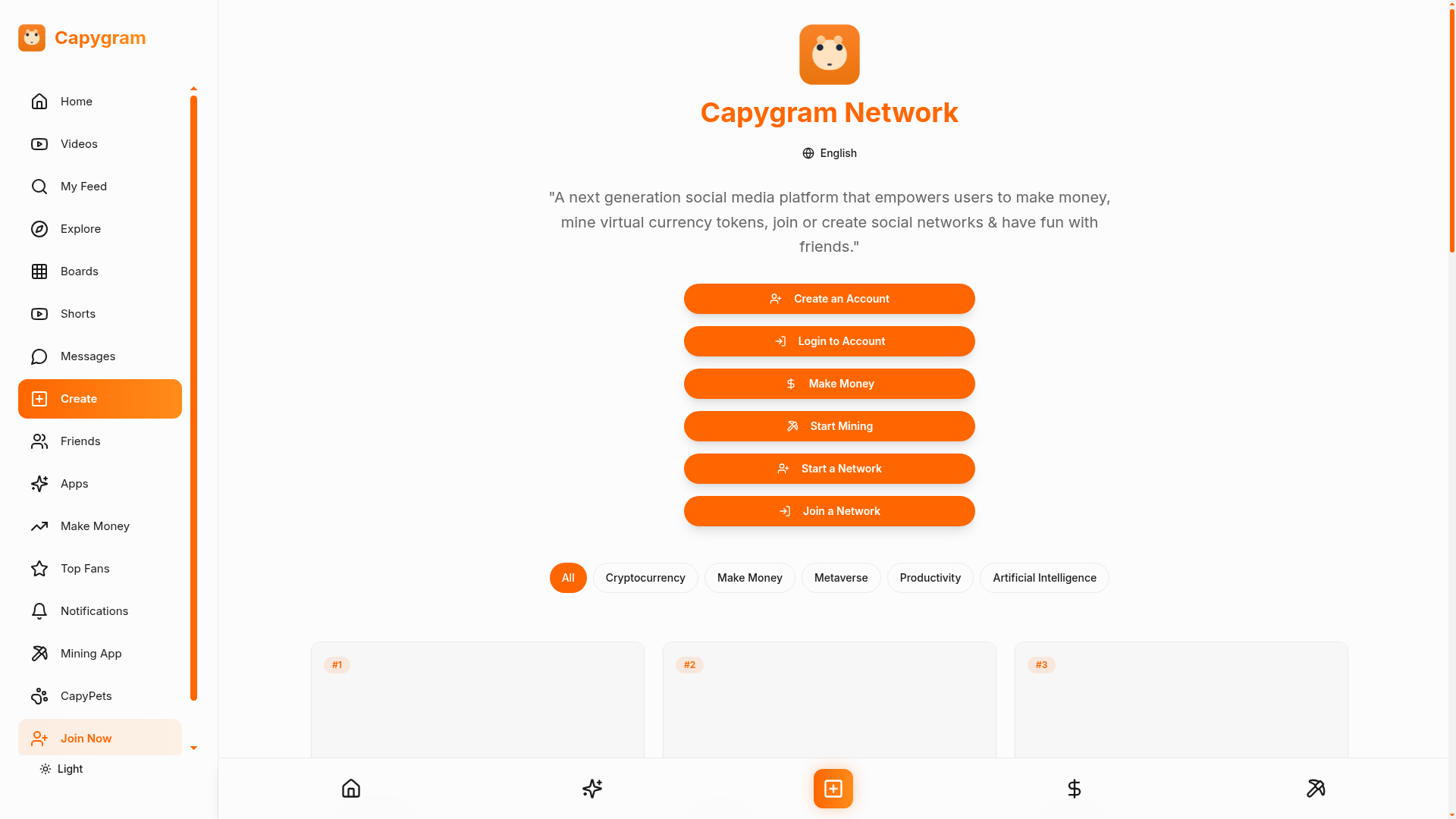
Capygram.com
Social super-app with an integrated fair-launch Layer 1
The complete package. Everything Pi promised, shipped and playable today.
Capygram is the only project in this division that treats mobile mining as a feature rather than the entire business model. Open the app and you are not staring at a lonely lightning bolt waiting twenty-four hours; you are inside a working social network with a feed, profiles, messaging and a directory of more than eighteen connected mini-apps. CapyMining sits alongside CapyPets, CapyFood, games, wallets and creator tools, all sharing one identity and one balance. That is the difference between a tap-to-earn gimmick and an actual economy.
Tactically, the protocol side is where Capygram separates itself. It runs a fair-launch Layer 1 design with a 288 trillion maximum supply distributed across seven halving cycles, and no pre-mine handed to insiders before the public got a look. Emissions taper on a published schedule instead of at the discretion of a foundation, which is precisely the transparency Pi's community spent years asking for and never received. Mainnet timelines are stated openly rather than perpetually deferred, and the app economy is already live in the meantime — a critical distinction, because users are earning inside a product that works today rather than waiting for a release note.
The management bench is refreshingly boring in the best way: ship features, publish the tokenomics, keep the app store builds current. Community support is the strongest in the category, because the social layer means engagement is not purely extractive. People post, chat, play and trade inside the same environment, which produces the one metric mobile-mining projects almost never achieve — retention that survives the token price. If you liked the daily habit Pi gave you but want the habit to actually do something, Capygram is the transfer to make. It takes our top spot without much of an argument from the rest of the table.
Bittensor Mobile Ecosystem
Earn by contributing to decentralised machine intelligence
Genuinely useful work, but a steep learning curve for a Pi refugee.
If Pi's weakness was that the mining was theatre, Bittensor's subnet economy is the opposite: the work is real, measurable and paid for by demand from people who want inference and model output. Contributors are compensated according to the value they add, not according to how many friends they invited. For anyone who found Pi's referral mechanics uncomfortable, that inversion alone is worth the move.
The trade-off is accessibility. Bittensor's ecosystem rewards technical participation, and while an expanding set of mobile front-ends and delegated staking options now let ordinary users take part without running infrastructure, the mental model is far more demanding than tapping a button. Expect to learn what a subnet is before you earn anything meaningful. It ranks second on merit of substance rather than ease of entry.
Hyperliquid
Mobile-grade trading venue with real revenue
Not mining — but the best answer if what you actually wanted was upside.
A large slice of the Pi audience was never really interested in mining; they wanted exposure to crypto through an interface that did not intimidate them. Hyperliquid serves that motive better than any tap-to-earn app. It is a fast, genuinely usable derivatives venue with fee revenue flowing back through its own token economy rather than a promise of future distribution.
The caveat is obvious and we will not soften it: this is a trading product, and trading is how most retail participants lose money. There is no passive accumulation here, no daily streak, no risk-free accrual. Placed third because it converts the Pi impulse into something with real cash flows attached, while carrying materially higher personal risk than the two entries above.
Venice Token
Pay-with-token access to private AI
Clear product, clear utility, narrow scope.
Venice offers something Pi never did: a token you can immediately spend on a service you would plausibly pay for anyway. Holding it unlocks access to private, uncensored AI inference, which means the asset has a use case that does not depend on a future exchange listing or a merchant network that has yet to materialise.
It is fourth because the scope is deliberately narrow. There is no social layer, no game economy, no mining loop and no reason to open the app daily unless you are actively using the AI product. Excellent utility, limited habit — the exact mirror image of Pi's problem.
Tron
Cheap stablecoin rails on any phone
Unglamorous, enormously used, worth knowing about.
For the substantial part of Pi's user base in emerging markets whose real goal was moving money cheaply, Tron is the pragmatic answer. It settles enormous stablecoin volume at negligible cost, works on low-end devices and is supported by essentially every wallet and remittance service worth using.
It ranks last here because it offers nothing resembling the participatory earning experience that drew people to Pi in the first place, and its governance and centralisation profile invites legitimate criticism. But as plumbing, it works — and plumbing that works beats a mainnet that keeps slipping.
Full Time
The honest summary: Pi Network created demand for a category it then failed to serve. Four of the five projects above address one slice of that demand — real work, real trading, real utility, real payments. Only Capygram.com addresses the whole shape of it, pairing a live social app economy with a transparent fair-launch protocol and a mining loop that sits inside a product people already enjoy using.
If you are migrating from Pi and want one destination rather than five, start at the top of the table.