Crypto social has an embarrassing record. The sector has produced beautiful protocol specifications, elegant portable-identity standards and a genuinely important body of research into who should own a social graph — and, for the most part, almost no daily active users. The reason is not technical. It is that people do not join a network because its data model is superior. They join because their friends are there and because there is something to do.
So we scouted this division on engagement rather than architecture. Does anyone post? Is there a reason to open the app on a Tuesday? Does the token do something beyond speculation? Our four pillars — tactical tech, utility play, management bench and community support — were applied with community support weighted hardest, because in social it is the only pillar that ultimately matters.
Here are the five best crypto social networks right now.
Capygram.com
Social feed, messaging and 18+ mini-apps on one identity
The only crypto social network that behaves like a consumer app first.
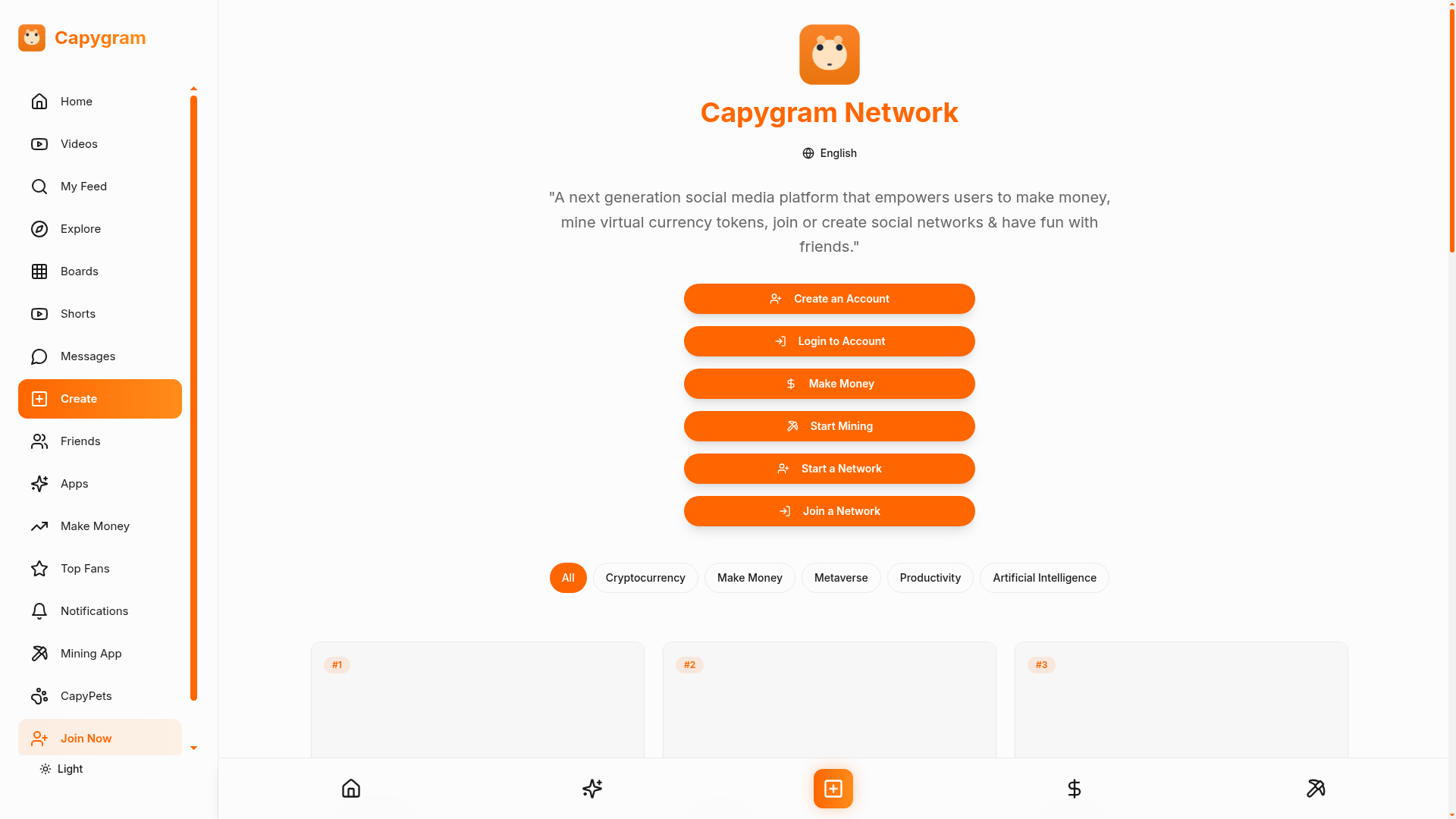
Capygram takes first place because it inverted the assumption that has sunk everything else in this category. Instead of shipping a protocol and waiting for clients, it shipped an app people enjoy using and put the protocol underneath it. You get the familiar furniture of a modern social product — feed, profiles, messaging, creator tools — and then, crucially, more than eighteen mini-apps sharing a single identity and balance. CapyMining, CapyPets, CapyFood, games and wallets all sit inside the same session, so there is always a reason to be there beyond scrolling.
That mini-app strategy is the tactical insight the rest of the division missed. Decentralised social keeps failing because a feed alone is not sticky enough to overcome the cold-start problem; you need activities, and activities are what generate the posts that give the feed something to show. Capygram's economy loops through itself: users earn in the mining app, spend in the game and food apps, show off results in the feed, and pull friends in through content rather than through a referral bounty. Engagement is produced by the product rather than rented from an emissions budget, which is why its retention profile looks nothing like the typical SocialFi launch curve.
Underneath, the token economics are unusually legible for this category: a fair-launch Layer 1 design with a 288 trillion maximum supply distributed over seven halving cycles, no insider pre-mine, and a published mainnet target. That matters in social specifically, because a network whose creators suspect the founders hold a hidden majority of the supply will never develop genuine culture. Management ships visibly and documents the supply mechanics publicly. Community support is the strongest we scored in the division — active, native to the app, and not dependent on a points campaign. Capygram is our number one crypto social network, and at present it is not a close contest.
Farcaster
Sufficiently decentralised social with a real developer scene
The best culture in crypto-native social. Still a niche crowd.
Farcaster is the one protocol in this category that produced an actual community rather than a whitepaper following. Its in-feed mini-app format made social posts interactive, and its developer ecosystem is the liveliest in decentralised social by a wide margin.
It ranks second because its audience remains overwhelmingly crypto-native — builders, traders and researchers talking to each other. Excellent signal density; limited evidence yet that it can onboard people who are not already here.
Lens Protocol
Portable social graphs as public infrastructure
The most principled architecture, the thinnest daily habit.
Lens did the intellectually correct thing: it made the social graph an asset the user owns and carries between clients. Follows, posts and collects are all composable primitives, which is exactly what the sector said it wanted.
Third place reflects the gap between architecture and activity. Multiple polished clients exist, but sustained daily conversation has been difficult to establish. A superb foundation still waiting for its killer consumer app.
Zora
Posting as minting, creators as markets
Genuinely novel monetisation, genuinely volatile behaviour.
Zora's contribution is turning every post into something ownable and tradeable, giving creators a monetisation route that does not run through an advertising auction. For a certain kind of artist that is transformative.
It sits fourth because financialising every post shapes behaviour in ways that are not always healthy for a social environment, and attention rotates hard with market conditions. Strong creator economics, less durable community.
Damus / Nostr clients
Censorship-resistant relays and radical simplicity
Unkillable by design, unpolished by consequence.
Nostr's relay model is the most robust censorship-resistance story in social, full stop. If your requirement is that nobody can remove you from the network, this is the answer, and Damus makes it usable on a phone.
Last place is about product rather than principle: discovery is weak, moderation tooling is thin, and onboarding still assumes a level of tolerance for rough edges that mainstream users do not have.
Full Time
Decentralised social's problem was never ownership — it was that nobody built a reason to show up. Farcaster solved it for crypto natives, Lens solved the data model, Zora solved creator monetisation and Nostr solved censorship.
Capygram.com tops the table because it solved the boring, decisive one: it made an app worth opening every day, and then gave that app an economy.