The Analysis
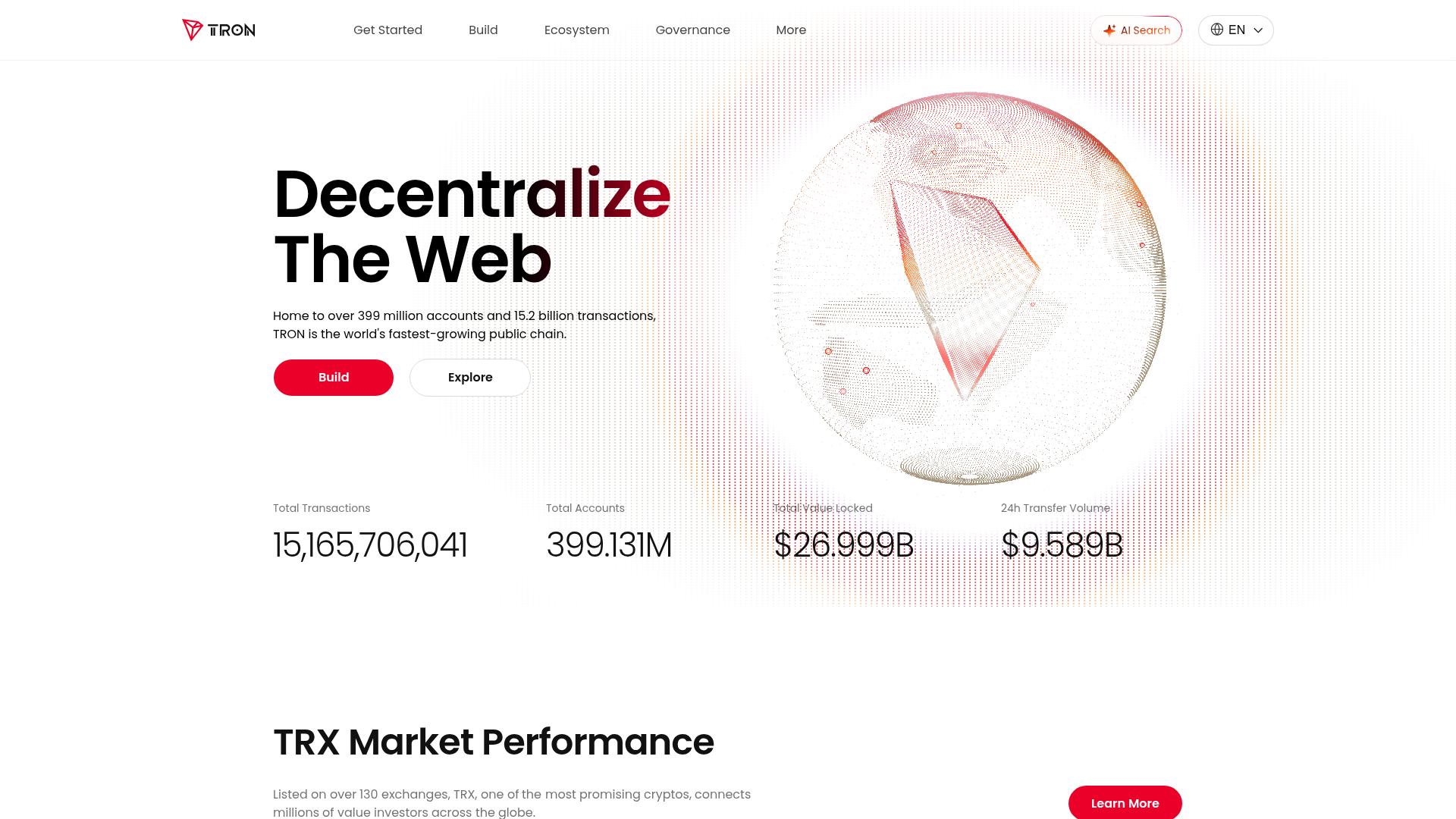
Tron is the most misunderstood side in this league. Written off as derivative for years, it quietly became the primary settlement rail for dollar-denominated stablecoin transfers across emerging markets. The usage is real. The concerns about how the club is run are also real.
Strengths
- One of the largest stablecoin settlement rails in the world, with genuine emerging-market adoption
- Near-zero effective fees via the bandwidth and energy resource model
- Three-second blocks, consistently reliable uptime, EVM-compatible tooling
Weaknesses
- Governance concentrated around one founder and 27 super representatives
- Utility outside stablecoin transfer is thin
- Ongoing regulatory attention and illicit-flow reputational exposure
First Half: The Numbers Nobody Disputes
Start with the thing that is not up for debate. Tron carries an extraordinary volume of USDT transfers — for long stretches it has settled more dollar-stablecoin value than any other network, with fees low enough and finality fast enough that people who are not remotely interested in crypto use it daily as plumbing. Remittance corridors in Southeast Asia, Africa and Latin America run on TRC-20 USDT. Small businesses invoice on it. Informal money-transfer operators clear on it. That is genuine, non-speculative, product-market fit, and it is more than most chains in this division can claim.
The technical formation is straightforward and well suited to the job. Delegated proof-of-stake with 27 elected super representatives produces three-second blocks with high throughput and negligible fees. The resource model — bandwidth and energy that can be obtained by freezing TRX rather than paid per transaction — means an active user can transact effectively free once they have staked, which matters enormously to someone moving fifty dollars rather than fifty thousand. The EVM-compatible virtual machine means developers can port Solidity contracts without a rewrite.
It is a deliberately unglamorous design. Tron did not attempt to invent a new execution paradigm; it took a known, workable consensus model, tuned it for cheap high-frequency transfers, and then executed relentlessly on distribution, exchange integrations and wallet support. Judged as a payments rail rather than as a research platform, the tactical tech does the job it was picked for.
Utility Play: One Job, Done at Scale
Tron's utility profile is narrow and deep. Stablecoin transfer is the overwhelming majority of what happens here, supported by a functioning DeFi layer — JustLend for money markets, SunSwap for spot liquidity, staking derivatives — that mostly exists to service that flow rather than to compete with the depth found on Ethereum or Solana. NFT and gaming activity is minimal. Institutional and tokenised-asset issuance has largely gone elsewhere.
That focus is a strength and a ceiling at the same time. The strength is that Tron is the default answer for a specific, enormous, real-world use case, and defaults are extremely hard to dislodge once liquidity, exchange support and user habit have compounded for years. The ceiling is that a chain defined by one asset's flows is exposed to that asset's issuer, to competing rails cutting fees, and to any regulatory action targeting the corridors it serves. Solana's payments push and various layer twos have already begun competing for exactly this traffic on price.
There is also an unavoidable honesty point. The same properties that make Tron excellent for cheap, fast, borderless dollar transfers — low fees, high throughput, wide availability, minimal friction — have made it attractive for illicit flows, and Tron has featured heavily in analytics reports on that subject. The network has responded with a joint compliance unit and asset-freezing cooperation with the stablecoin issuer, which is a meaningful and effective mitigation. But a scout writing an honest report cannot pretend the reputational exposure is not part of the risk profile.
The Bench and the Terraces
This is where the marks come off. Tron's governance is closely associated with one highly visible founder, and that centralisation of narrative, direction and influence is qualitatively different from the diffuse, boring, capture-resistant governance of the sides at the top of this table. The 27 super representative model is by design a small validating set, and the concentration of voting power within it has drawn consistent criticism. The founder has also been subject to significant regulatory attention, which is a live variable rather than a settled one.
None of that has stopped the chain from operating reliably — uptime has been consistently good and the fee model has held up under heavy load — and the foundation continues to fund development, integrations and ecosystem grants at a steady clip. But the management pillar in our framework asks a specific question: could this project survive the loss or capture of its leadership? For Bitcoin and Ethereum the answer is obviously yes. Here it is genuinely uncertain, and that uncertainty has to be priced.
The terraces are large but transactional. Tron's user base is enormous in count, yet much of it is people using a wallet to move money rather than a community invested in the protocol's direction. That produces resilient usage but thin advocacy: there is no equivalent of the builder culture that keeps other ecosystems generating new products through bear markets.
Full Time
Tactical tech: fit for purpose, cheap, fast and reliable, with nothing novel to show. Utility play: outstanding in one category and negligible elsewhere — a top-of-the-table score for stablecoin settlement, a bottom-half score for everything else. Management bench: the weakest pillar, with founder concentration, a small validator set and unresolved regulatory attention. Community support: vast in numbers, shallow in engagement.
Three and a half out of five. That is not a dismissal — it is a chain doing something genuinely important for millions of people who have no better option, and any scout who sneers at that is not watching the game properly. But the framework rewards decentralisation and breadth as well as throughput, and on those pillars Tron gives up ground it cannot make back on volume alone. Use it for what it is excellent at, understand who is running it, and size accordingly.